MB-1 manual
MB-1 turns the FM-1 into an aggressive monophonic virtual analog synthesizer, after the Arturia MiniBrute and measured against its MiniBrute V plugin. One voice, last-note priority: hold a key, play another, let it go, and the first comes back (with glide, if GLIDE is up). It keeps 128 patches, has an arpeggiator, a 64-step sequencer and five effects, and comes with a patch editor in the browser. A two-page cheat sheet (PDF) sums this manual up, to keep beside the FM-1.
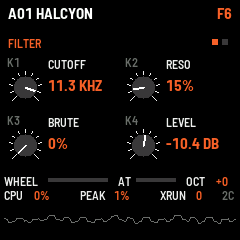
The screen
MB-1 starts with its own screen: the four waveforms, its name and what it is. Then, in the site's dark colours (black, the panel's grey, white labels, orange values):
At the top: the patch slot (A01..D32) and its name (a * when it has changed since it was saved) and the note playing. In the middle: the page, and its four parameters, one for each of K1..K4, each drawn as on the patch editor's sheet (a knob, a fader for the mixer and the envelopes, a slide switch for the two- and three-way choices) with its value; the one being turned lights up, its pointer orange. At the bottom: the mod wheel, the keys' pressure (aftertouch), the octave, the audio load (CPU: now, PEAK: the most since power-on, in % of the time the FM-1 has for each block of sound; XRUN: blocks it missed, heard as clicks), and the sound as a scope.
The controls
| Control | What it does |
|---|---|
| K1..K4 | The four parameters on screen. A fast turn moves in bigger steps. |
| HOME, SEL, ENV, LFO, EDIT, GLO, FX | A section of the patch sheet: its first page; pressed again, its next page. Held half a second: back to its first page. The dots at the top right: the button's pages, the one on screen lit. GLO holds the instrument's own settings (not the patch's) |
| HOME three times | RANDOM: HOME pressed three times in a row (each within 0.4 s) makes a new patch with random settings, named RND001, RND002 and so on (as SQ-80's), and not in any slot until you SAVE it. Every one sounds: an oscillator up, the amp envelope heard, the filter where its mode passes; the rarer sources and the effects now and then. LEVEL, BEND and the arpeggiator stay as they were |
| SELECT | Steps through every page |
| ALGO | The mod wheel (sent as MIDI CC 1 too). Where it goes: CONTROLS (EDIT), WHEEL TO |
| PRESET | The patch slot, A01..D32: 128 slots in four banks of 32. Turning it loads the slot (unsaved changes are dropped) |
| SAVE | Pressed once: the save screen. K1 moves along the name and K2 changes the letter under it (A-Z, 0-9, space and - # & + . !); PRESET picks where, any of the 128 slots (its own first; the screen names the patch it would replace). SAVE again stores it there, with its name, and plays from there. Any other button cancels (the name as it was). Lit when there is something to save |
| OCT- / OCT+ | The keyboard's octave, -2..+2 |
| ARP | The arpeggiator: OFF, ON, HOLD in turn (and its page). Held half a second: its pages, ARP and ARP 2. Lit while it runs, dark a moment on each beat |
| SEQ | The sequencer's page |
| PLAY | The sequencer: start (from the first step) and stop. Lit while it plays, dark a moment on each beat. With SEQ held: tap tempo, tap it on the beat |
| REC | Arms recording into the sequencer: stopped, step by step; playing, in time. Lit while armed |
| The keys | Notes with velocity; pressing harder is aftertouch |
The pages
| Page | Button | K1 | K2 | K3 | K4 |
|---|---|---|---|---|---|
| FILTER | HOME | CUTOFF | RESO | BRUTE | LEVEL |
| FILTER 2 | HOME | MODE | ENV AMT | KBD TRK | |
| SAW | SEL | SAW | ULTRASAW | US RATE | |
| SQUARE | SEL | SQUARE | PW | PW ENV | |
| TRI | SEL | TRI | METAL | MTL ENV | |
| SUB | SEL | SUB | SUB WAVE | SUB OCT | NOISE |
| FILT ENV | ENV | ATTACK | DECAY | SUSTAIN | RELEASE |
| AMP ENV | ENV | ATTACK | DECAY | SUSTAIN | RELEASE |
| VELOCITY | ENV | ENV VEL | AMP VEL | ||
| LFO | LFO | RATE | WAVE | LFO RTRG | |
| LFO AMT | LFO | PITCH | FILTER | PWM/MTL | AMP |
| VIBRATO | LFO | VIB RATE | VIB TYPE | ||
| PLAY | EDIT | PLAY | GLIDE | BEND | VINTAGE |
| CONTROLS | EDIT | WHEEL TO | WHL AMT | AT VIB | AT CUT |
| GLOBAL | GLO | TEMPO | HOLD ORD | LFO CLK | |
| DIST | FX | TYPE | DRIVE | TONE | MIX |
| CHORUS | FX | RATE | DEPTH | STEREO | MIX |
| DELAY | FX | TIME | FEEDBACK | TONE | MIX |
| DELAY 2 | FX | DLY SYNC | DLY MODE | ||
| REVERB | FX | DECAY | SIZE | DAMP | MIX |
| REVERB 2 | FX | PRE-DLY | FX ORDER | ||
| COMP | FX | THRESH | RATIO | ATTACK | RELEASE |
| ARP | ARP | MODE | OCTAVE | STEP | SWING |
| ARP 2 | ARP (held) | ARP | TEMPO | HOLD ORD | |
| SEQ | SEQ | PATTERN | LENGTH | STEP | SWING |
Each button is a section of the patch editor's sheet, and each page one of its columns or groups: SEL has a page for each waveform (its level, its shaper and the shaper's envelope amount), the SUB page the sub oscillator and noise. TEMPO and HOLD ORD are on ARP 2 as well as GLOBAL.
Notes on a few of them:
- ULTRASAW (SAW) adds two shifting copies of the sawtooth, as the hardware does: one moved by a slow LFO of its own, one by US RATE (beside it).
- METAL (TRI) folds the triangle through four folding stages (low settings fold only its top); MTL ENV and PWM/MTL move it with the filter envelope and the LFO.
- BRUTE (FILTER) feeds the sound after the VCA back into the oscillator mixer, as the hardware does: growl, then, near full, chaos (a low growl a third of the note's pitch). It follows the amp envelope.
- MODE (FILTER 2): LP, BP, HP and NOTCH as the Minibrute's Steiner-Parker filter makes them: HP keeps some low end, the notch is shallow.
- WHEEL TO (CONTROLS) is the Minibrute's mod wheel destination: LFO AMT, VIBRATO or CUTOFF; WHL AMT how far.
- VINTAGE (PLAY) detunes each note a little, the way an old oscillator drifts.
- PLAY (PLAY): LEGATO, a note played while another is held keeps the envelopes going (and glides); RETRIG, every note restarts them. BEND is the pitch bend's range, 1..12 semitones. LFO RTRG restarts the LFO with each note that starts the envelopes.
The arpeggiator
After the Minibrute's. ARP steps through OFF, ON and HOLD:
- ON plays the keys while you hold them.
- HOLD keeps playing the last chord when you let go; a key pressed with none held starts a new one. With HOLD ORD PLAYED (ARP 2, GLOBAL), the notes play in the order you pressed them, up to 16, a note as often as you play it: hold the first key down and tap the others (C held, then E, D, E: C E D E); with PITCH, a chord, low to high.
- MODE: UP, DOWN, UP/DOWN (the top and bottom notes play twice, as on the Minibrute) or RANDOM.
- OCTAVE: over 1 to 4 octaves.
- STEP: 1/4, 1/8, 1/16, or their triplets 1/4T, 1/8T, 1/16T.
- SWING: 50 % (straight) to 75 % in six steps: every second note comes later.
- TEMPO (ARP 2, GLOBAL): 30 to 260 BPM; or hold SEQ and tap PLAY on the beat. When MIDI clock comes in (USB, Bluetooth or TRS), the arpeggiator follows it, and TEMPO at its lowest halves it, at its highest doubles it.
- LFO CLK (GLOBAL): ARP puts the LFO on the arpeggiator's tempo; LFO RATE then picks a note value (8 bars dotted .. a 64th triplet), as the plugin's synced LFO.
Each note sounds for half its step. As in the plugin, the arpeggiator is the patch's: ARP (OFF, ON or HOLD), MODE, OCTAVE, STEP and SWING are saved with it, so picking a patch can switch the arpeggiator on. TEMPO, HOLD ORD and LFO CLK belong to the instrument (one tempo for every patch).
The effects
Five effects, after the plugin's and measured against them, saved with each patch: distortion, chorus, delay, reverb and a compressor, in that order (FX ORDER can put the reverb before the delay).
Delay and reverb. FX ORDER (REVERB 2): DLY>REV (the repeats into the reverb, the usual) or REV>DLY (the reverb's tail repeated), as each of the plugin's presets has them. They are stereo: the voice in the middle, the repeats and the reverb around it. With MIX at 0 an effect is off; half way, dry and wet are both at -3 dB (an equal-power crossfade, as the plugin's). Matched to the plugin's delay and reverb by measurement.
- DELAY: TIME 2 ms to 1.5 s (0.74 s in PING-PONG), on the plugin's scale; with DLY SYNC CLOCK (DELAY 2) it picks a note value instead (1/32 .. 1/1, triplets and dotted too) on the arpeggiator's and sequencer's tempo. FEEDBACK the repeats; TONE a low-pass on them (12 dB an octave; each repeat darker); MIX dry to wet. DLY MODE (DELAY 2): STEREO (the repeats in the middle) or PING-PONG (left, right, left...). Turning TIME glides, as tape does.
- REVERB: a plate. DECAY how long it rings (about 0.7 to 9 s at SIZE half way, as the plugin's), SIZE the room (it scales the decay too), DAMP how quickly it dies away, darker as it goes; MIX dry to wet; PRE-DLY (REVERB 2) a gap before it, 0 to 200 ms.
They run on the FM-1's second core while the first plays the voice (the screen's foot shows 2C). On a unit whose second core is unreliable (some are), MB-1 notices, gives it up until power-off, and runs them on the first (1C): the same sound, with less headroom. Only the effects are a block (6 ms) behind the voice; the dry sound is not.
Distortion, chorus, compressor, in the sound itself: the distortion first, then the chorus, then the delay and reverb (FX ORDER), the compressor last.
- DIST: TYPE SOFT (a rounded clip: the plugin's types 12, 13), HARD (10), ASYM (lopsided, even harmonics: 6, 7) or FOLD (folds back on itself as DRIVE rises: 9); DRIVE 0 to 48 dB (the level made up as it rises); TONE a low-pass after it, 1 to 20 kHz; MIX.
- CHORUS: the Juno-6's: RATE 0.33 to 15 Hz, DEPTH its sweep (up to 10 ms), STEREO the right's sweep against the left's (180 degrees: opposite, the Juno's), MIX.
- COMP: THRESH -60 to +20 dB, RATIO OFF (1:1) to 100:1, ATTACK, RELEASE; its makeup gain is automatic. On when RATIO is above 1:1.
These three run on the first core, in the sound itself, so they add no delay: the dry sound is never late. The distortion and chorus come before the delay and reverb (which hear them); the compressor comes last, on everything.
The sequencer
A 64-step monophonic step sequencer, after the KeyStep's (as on the MiniBrute 2), with 8 patterns. Each step is a note with its velocity, a rest, or a tie (the note before goes on through it). It runs on the arpeggiator's clock: TEMPO, a tap (SEQ held + PLAY), or MIDI clock (USB, Bluetooth or TRS) while it comes; the LFO follows it too with LFO CLK on ARP.
- The SEQ page: PATTERN 1..8, LENGTH 1..64 steps, STEP (1/4 .. 1/16T) and SWING (50..75 %), its own (not the arpeggiator's). A pattern changed while it plays takes over at the next step.
- PLAY starts it from the first step and stops it. While it plays, the arpeggiator rests and the keys play over it. MIDI Start, Continue and Stop run it too when the patch's arpeggiator is off.
- Step entry: stopped, press REC (lit; the screen shows REC and the step). Each key writes a step and moves on; FX writes a rest; holding the key and pressing FX writes a tie (the note goes on through that step). The pattern is as long as the steps entered (LENGTH changes it later). Press REC again to finish.
- Recording in time: while it plays, press REC. A key goes to the nearest step (the one playing, or the next if it is more than half over); held over the steps after, it writes ties. Press REC again to finish.
Each note sounds for half its step, or on through its ties. The patterns are stored by themselves (a couple of seconds after a change, while stopped; SAVE also stores them) and kept over power-off.
The patches
128 slots in four banks of 32, A01..D32: turn PRESET to pick one. Bank A holds the 32 factory patches: A01..A23 (HALCYON, TRENCH, NEBULA ... STARSHIP) were programmed on MB-1 after sounds of MiniBrute V's factory presets (approximations, with names of their own, effects and arpeggiator included), A24..A32 (SKWEESH ... VIBROPAD) were made with RANDOM; banks B..D start as INIT. A new install and the emulator start with them; on an FM-1 that already has patches, they stay as they are, and the patch editor's Factory bank A puts bank A's back (banks B..D are left alone). SAVE, PRESET, SAVE stores the patch in any slot (SAVE twice: its own). (Before 0.12 there were 32 slots: they are bank A now, as they were.) The patch editor (below) reads, edits and stores all of them, and keeps banks as .syx files.
The knobs' range
Every knob runs over the same range, with the same feel, as the MiniBrute V plugin's: the cutoff from 20 Hz to 20 kHz, the attacks to 12.5 s, the decays and releases to 25 s, KBD TRK to 200 %, GLIDE to 2 s an octave, the LFO from 0.05 to 100 Hz, VIB RATE from 1 to 50 Hz, US RATE from 0.005 to 43 Hz. A knob at the same place as the plugin's knob is the same setting.
The patch editor
The site's patch editor is a MiniBrute-style patch sheet that plays: every value of a patch on one panel, drawn like the paper sheets MiniBrute players fill in and share, in light or dark. It sounds in the browser with MB-1's own engine (the arpeggiator too, at the editor's tempo) and, with the FM-1 connected by USB (Chrome or Edge), on the FM-1 as you turn each control. It reads the FM-1's 128 slots (banks A..D) and the sound playing, stores a patch in a slot, writes a whole bank, opens and saves .syx files, and exports the sheet as SVG or PNG, or prints it.
Read a sheet loads a patch from a picture of a patch sheet, in the browser (nothing is uploaded):
- MB-1's own sheets (the editor's SVG and PNG carry the patch inside them): exactly.
- electric-himalaya.com's MiniBrute sheets (the pictures with yellow dots): the dots, the faders, the switches, the filter mode's letters, the LFO's wave.
- Ultimate Patches' sheets: a PDF (every page, its title as the name; All into the slots puts them in the slot list from the one picked), or a picture of a page.
A window shows the sheet with what was read on it: green read, orange told apart by its shape or a switch whose order is a guess (check those by ear: they keep a dashed ring on the editor's sheet until you touch them), grey not on the sheet (INIT's value). The MiniBrute's PHONES, MASTER, FINE TUNE, AUDIO IN, ENV SPEED, CLOCK, TEMPO and OCTAVE are left out, and MB-1's effects stay off. Photographs of a sheet or of a MiniBrute are not read yet. Reading the FM-1 needs MB-1 0.11.4 or later, all 128 slots 0.12 or later. Every control on the sheet has its CC (below): a controller or a DAW can play them the same way.
Loading patches from a computer
MB-1 takes patches over USB MIDI SysEx (F0 7D 4D 42 ..., app/app.c "the loader"): a patch into a slot (01; slots 0..127 are A01..D32), the slots stored (02), bank A's factory patches back (03; banks B..D are left alone), a slot played (04), a slot's patch sent back (05), what is there (06: the parameter count, the banks of 32, the slot playing, edited or not), a patch played without a slot (07, as an edit: SAVE keeps it), and the sound playing sent back, edits included (08). Each frame is answered.
MIDI
MB-1 plays from USB, Bluetooth and TRS MIDI on any channel: notes, pitch bend (PLAY: BEND, 1..12 semitones), the mod wheel (CC 1), aftertouch (channel or poly), all notes off (CC 120, 123), and every parameter by its CC. The keys and the knobs are sent out over USB and Bluetooth.
| CC | Parameter | Page |
|---|---|---|
| 74 | CUTOFF | FILTER |
| 71 | RESO | FILTER |
| 20 | BRUTE | FILTER |
| 21 | ENV AMT | FILTER 2 |
| 22 | MODE | FILTER 2 |
| 23 | KBD TRK | FILTER 2 |
| 24 | ENV VEL | VELOCITY |
| 25 | AMP VEL | VELOCITY |
| 26 | SAW | SAW |
| 27 | SQUARE | SQUARE |
| 28 | TRI | TRI |
| 29 | SUB | SUB |
| 30 | NOISE | SUB |
| 31 | ULTRASAW | SAW |
| 75 | PW | SQUARE |
| 76 | METAL | TRI |
| 77 | ATTACK | FILT ENV |
| 78 | DECAY | FILT ENV |
| 79 | SUSTAIN | FILT ENV |
| 80 | RELEASE | FILT ENV |
| 73 | ATTACK | AMP ENV |
| 81 | DECAY | AMP ENV |
| 82 | SUSTAIN | AMP ENV |
| 72 | RELEASE | AMP ENV |
| 83 | RATE | LFO |
| 84 | WAVE | LFO |
| 85 | PITCH | LFO AMT |
| 86 | FILTER | LFO AMT |
| 87 | PWM/MTL | LFO AMT |
| 88 | AMP | LFO AMT |
| 89 | VIB RATE | VIBRATO |
| 90 | VIB TYPE | VIBRATO |
| 5 | GLIDE | PLAY |
| 91 | VINTAGE | PLAY |
| 92 | WHEEL TO | CONTROLS |
| 93 | WHL AMT | CONTROLS |
| 94 | SUB OCT | SUB |
| 95 | SUB WAVE | SUB |
| 96 | US RATE | SAW |
| 7 | LEVEL | FILTER |
| 102 | PLAY | PLAY |
| 103 | BEND | PLAY |
| 104 | LFO RTRG | LFO |
| 105 | ARP (off, on, hold) | ARP 2 |
| 106 | MODE | ARP |
| 107 | OCTAVE | ARP |
| 108 | STEP | ARP |
| 109 | SWING | ARP |
| 110 | TIME | DELAY |
| 111 | FEEDBACK | DELAY |
| 112 | TONE | DELAY |
| 113 | MIX | DELAY |
| 114 | DLY SYNC | DELAY 2 |
| 115 | DLY MODE | DELAY 2 |
| 116 | DECAY | REVERB |
| 117 | SIZE | REVERB |
| 118 | DAMP | REVERB |
| 119 | MIX | REVERB |
| 14 | PRE-DLY | REVERB 2 |
| 15 | FX ORDER | REVERB 2 |
| 16 | TYPE | DIST |
| 17 | DRIVE | DIST |
| 18 | TONE | DIST |
| 19 | MIX | DIST |
| 52 | RATE | CHORUS |
| 53 | DEPTH | CHORUS |
| 54 | STEREO | CHORUS |
| 55 | MIX | CHORUS |
| 56 | THRESH | COMP |
| 57 | RATIO | COMP |
| 58 | ATTACK | COMP |
| 59 | RELEASE | COMP |
| 97 | AT VIB | CONTROLS |
| 98 | AT CUT | CONTROLS |
| 99 | PW ENV | SQUARE |
| 100 | MTL ENV | TRI |
Choices (MODE, WAVE, ...) take the CC range in equal parts.